Overview
Our course is accredited with EMDRAA and meets the stringent requirements for ensuring all trainees leave the training fully equipped to safely practice EMDR in their own practices.
Our EMDR Comprehensive Training equips clinicians with the knowledge, skills, and confidence to integrate EMDR therapy into their practice. Delivered either online, in hybrid format or five days in person, this training combines live demonstrations, supervised practice, and structured learning to support safe and effective clinical application.
In line with the EMDRAA requirements all participants are expected to demonstrate their EMDR skills in the training and also have the experience of EMDR as a client.
These experiential components occur small groups practicums with at least one facilitator for every twelve participants.


Mental health professionals who are interested in furthering their skills to better support their clients are eligible.
However, EMDRAA does have specific requirements around eligibility, to check you are eligible to be trained in EMDR therapy, please check the EMDR Association of Australia (EMDRAA) eligibility guidelines before registration.
Who can do EMDR therapy training?
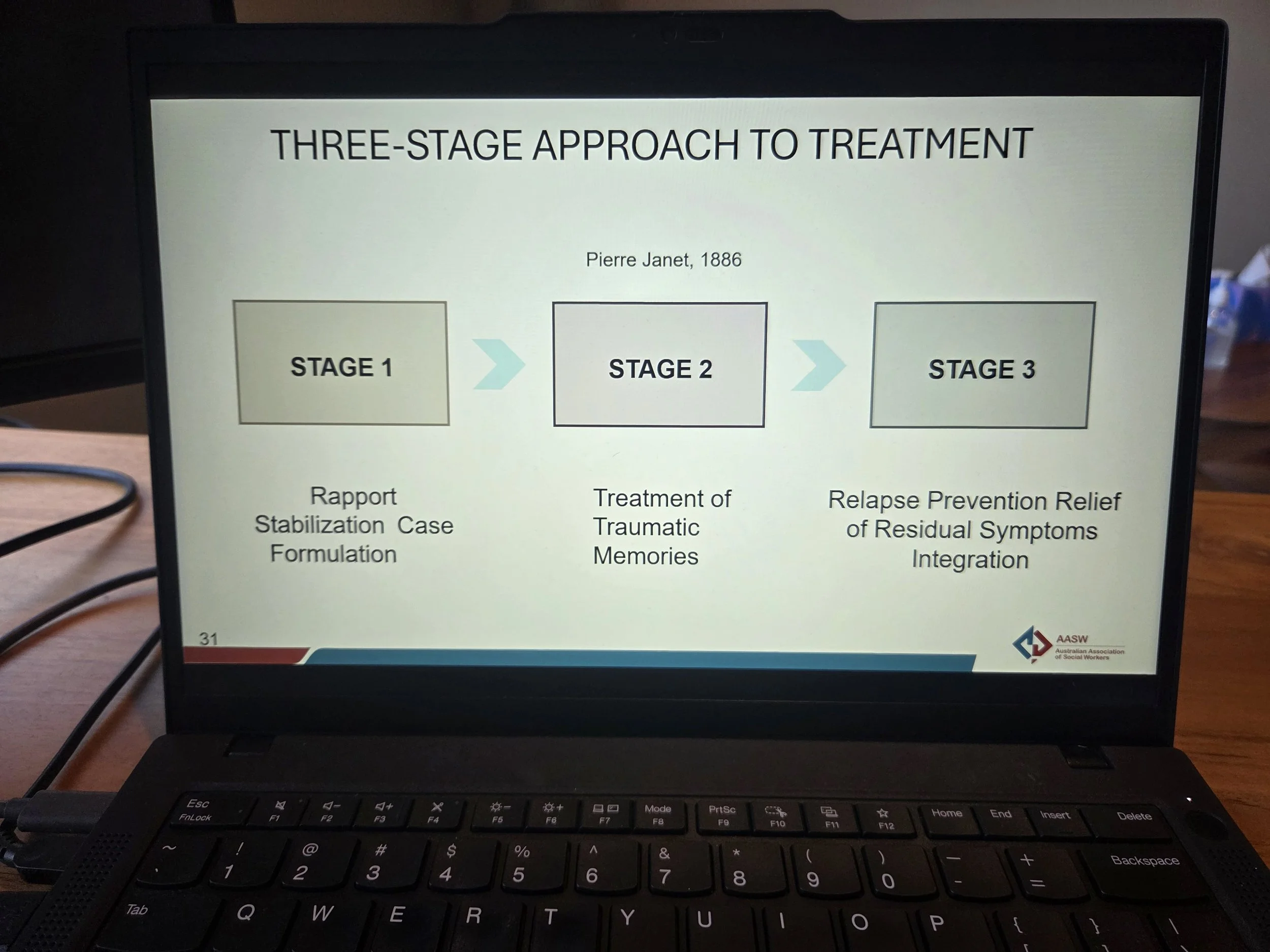
Training Structure
5 days ( 40 hours which includes 20 hours of didactic teaching, 20 hours of practical experience + 10 hours group consultation).
The 10 hours of group consultation is offered after the 40 hours of training and there are various opportunities to engage with different consultants on the Adaptive Edge team to learn how each clinician uses EMDR in their own practice.
The consultation hours are included in the fees which includes a significant cost saving benefit.
We aim to provide you with the foundational knowledge of EMDR with a solid understanding of the Adaptive Information Processing model that it rests on, as well as the importance of understanding the meaning making which impacts on the negative belief networks that occur when clients have experienced trauma and how this impacts on their current and future functioning.
You will become confident in being able to use the Standard Protocol, following the procedural steps to accurately assess the presenting concerns (case conceptualise) and then determine the most appropriate application of EMDR.
You will learn the procedural steps of how to do EMDR under the encouraging guidance and support of your facilitators in a small group.
The course also covers considerations to be aware of with complex presentations, cultural and identify affirming practices, and specific clinical populations, including developmental and attachment disorders, dissociation and neurodiversity, to name a few.
Online, in-person or hybrid
What’s included:
Manual
Scripts
Worksheets
Consultation (group and individual)
Access to online resources

Our courses can be presented in online format, or a hybrid of both online and in-person or even 5 days in person.
Learning outcomes
Understanding of neurobiology of trauma and why EMDR works
Stabilisation strategies
Case conceptualisation using the AIP model of understanding trauma and principles of recovery
Awareness of cultural implications and adjustments required
Assessment and preparation skills for commencing processing.
Protocol application (standard and modifications for specific populations)
The use of interweaves when processing becomes stuck, how to manage blocking beliefs, making sure the client stays within their window of tolerance
ONLINE :
27 -28 August 9am - 5pm AEST
10 - 11 September 9am - 5 pm AEST
3 October 9am - 5 pm AEST
TRAINER : Anna-Michele Antoine Cooper
Commencing 27th August (+ 4 more dates)
Upcoming Trainings
HYBRID in Launceston, TAS
Online 12 - 13 February 2027 9am - 5pm AEST
In person 26 - 27 February 2027 9am - 5 pm
Online 19 March 2027 9am - 5 pm
TRAINER : Dee Cooper
Be the first to know about upcoming trainings
Advanced EMDR workshops
Please keep revisiting this page as we add more trainings!
Advanced skills for trained EMDR clinicians
Workshop topics:
Complex trauma
Dissociation
Attachment Focused EMDR
EMDR with Children
Culturally sensitive EMDR
EMDR and neurodivergence